
What is an emotional ladder?
An emotional ladder is a way of visualising how weak or strong your emotions are.
As you feel an emotion more strongly, the higher up the ladder you go. And as emotions become less intense, you go down the ladder.
You can make a picture of an emotional ladder to use with your child.
How an emotional ladder can help your child
An emotional ladder can help you and your child understand:
- how strong their emotions are in different situations
- what they can do to manage emotions at different levels
- when your child might need extra support from you
- what different levels of an emotion feel like
- what signs to look for as the emotion becomes stronger.
When your child can recognise early signs that their emotions are getting stronger, they can use strategies to calm down before they get overwhelmed.
An emotional ladder picture can be particularly helpful for children who regularly experience strong emotions. This might include some children with disability, children with ADHD, autistic children, children with other additional needs, and children who’ve experienced significant stress or trauma.
What you need to make an emotional ladder picture
- A large piece of paper
- Pencils or felt-tip pens
You and your child can make an emotional ladder picture together. It’s best to make the emotional ladder picture when your child is feeling calm and ready to do the activity.
How to make an emotional ladder picture
You can create an emotional ladder for any emotion. Here’s an example for anger.
Step 1
Draw or ask your child to draw a picture of a ladder.
Step 2
Number each rung on the ladder from 1 to 5, and add a label:
- Rung 1 is not angry – everything is OK.
- Rung 2 is a little angry – for example, when I forget to take my homework to school.
- Rung 3 is moderately angry – for example, when someone is mean and plays a joke on me.
- Rung 4 is very angry – for example, when someone pushes me over on purpose.
- Rung 5 is extremely angry, and I’m going to explode like a volcano – for example, when someone deliberately rips up my work.
Here’s an example of an emotional ladder picture for anger. Download and print this emotional ladder picture (PDF: 358.9kb).
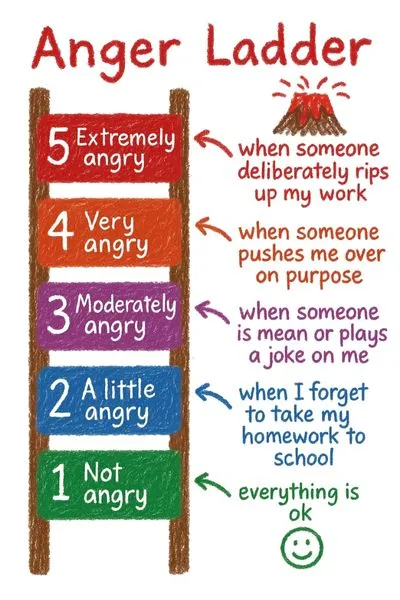
This image was generated using ChatGPT.
How to use an emotional ladder to help your child with their emotions
You can use an emotional ladder picture to help your child learn to listen to their body and connect their emotions to their physical feelings. It’s good to use the ladder regularly to talk about how your child is feeling.
Tips
- Check the ladder when your child is feeling relatively calm. This can help your child recognise that their emotions go up and down in strength.
- Encourage your child to think about how their body feels on different rungs. You could share how you feel. For example, ‘When I’m feeling angry and I’m on step 3, my face feels warm and my heart beats faster. What do you notice in your body when you’re feeling moderately angry?’
- Ask your child what situations might be linked to different rungs. For example, ‘I’ve noticed sometimes you look angry when we’re in a hurry. Which step do you think you’re on when that happens?’
- Talk with your child about what helps them on different rungs and how calming down is easier on lower rungs. For example, ‘When you’re on rung 5, having a quiet cuddle with your favourite toy seems to help. Is that right?’
- After your child has experienced a strong emotion, use the ladder to talk about how they felt. It’s best to do this afterwards because your child might not be able to listen or engage with the ladder while they’re experiencing the emotion.
- Use ‘ladder’ language when you’re talking about emotions. For example, you could talk about emotions ‘climbing up the ladder’, or ask your child how you can work together to help them ‘climb down the ladder’.
How to adapt an emotional ladder for children of different ages
How you use an emotional ladder picture will depend on your child’s age and their ability to recognise and respond to their emotions.
Younger children
- Use familiar examples. For example, label the rungs of the ladder with events from your child’s everyday life, like losing a toy or leaving the playground.
- Suggest simple strategies to respond to emotions, like taking deep breaths, getting a drink of water or asking for help.
- Use pictures instead of words for the labels. For example, the label on rung 1 could be a smiley face emoji, and the label on rung 5 could be an exploding head emoji.
- Instead of a ladder, use a picture of a volcano. Mild emotions could be at the bottom of the volcano and stronger emotions as you reach the exploding top.
Older children
- Use more complex emotion words like ‘annoyed’, ‘irritated’, ‘concerned’, ‘bothered’, ‘exasperated’, ‘overwhelmed’ or ‘furious’.
- Think about early warning signs. Encourage your child to identify thoughts, body sensations and behaviour that show them an emotion is getting more intense.
How to adapt an emotional ladder for children with diverse abilities
How you use an emotional ladder picture will depend on your child’s ability to recognise, describe and respond to their emotions.
Communication
If your child’s language skills are still developing, use pictures instead of words for the labels. For example, the label on rung 1 could be a smiley face emoji, and the label on rung 5 could be an exploding head emoji.
Low vision
Your child might need you to use large, clear images and colours with good contrast. You could also describe the different levels verbally and use objects, sounds or differently textured fabric or materials to represent each level.
Restricted mobility
You could place the emotional ladder where it’s easy for your child to see or reach. Or you could use a digital version.
Sensory sensitivities
You could reduce other sensory stimulation while you and your child do this activity. For example, lower the volume or turn off background music and avoid flashing lights or screens. Check in with your child regularly to ask whether they’re enjoying it.
You can get more ideas for adapting this activity from our articles on play and autistic children and play and children with disability. You might also like to explore our other activity guides. They can all be adapted to suit children with diverse strengths and abilities.