
What is the ‘big deal, little deal’ concept?
The ‘big deal, little deal’ concept is a tool to help children learn that not all problems are the same size. Some problems are small and can be sorted out quickly. Others are bigger and need more time, help or support to solve or manage.
This concept helps kids pause and think:
- How big is my problem?
- Who can help?
- What might help?
Why is it important for kids to understand the size of a problem?
When your child learns to tell the difference between big and little problems, it can help them:
- build problem-solving and decision-making skills
- feel more confident solving small problems on their own
- cope better when big things happen or when they can’t change things
- know when, how and who to ask for help with problems.
Examples of big, medium and little problems for kids
Little problems
These are small issues that your child can usually solve quickly or with a little help. For example:
- breaking a pencil
- having to wait for a turn
- losing a game
- spilling a drink
- making a minor mistake in schoolwork
- losing or misplacing something that can easily be replaced or found.
Medium problems
These are problems that might take your child more time or that might need more help to sort out. For example:
- arguing with a friend
- being left out of a group or having difficulty making friends
- needing to have a minor medical procedure
- disagreeing with a family member
- losing something important that needs to be found or replaced.
Big problems
These are serious issues that your child can’t solve on their own or that can’t be solved at all. For example:
- being hurt, threatened or bullied
- experiencing abuse or violence
- experiencing a traumatic event, like a serious accident, death, parental separation or serious illness.
Some big problems can’t be fixed or changed. For these sorts of problems, the best response might be asking for support, staying safe, managing difficult feelings and finding helpful ways to cope.
What is a size of the problem activity?
This is an activity that can help your child understand problem size by sorting problems into the following categories:
- little deal
- medium deal
- big deal.
What you need for a size of the problem activity
- Paper
- Pens, markers or coloured pencils
- Optional: 3 bowls or containers in red, orange and green
- Optional: some prewritten examples of problems and reactions or solutions
It’s best to do the activity when your child is feeling calm. You can do the activity regularly to help your child work out the size of different problems.
How to do a size of the problem activity
Step 1: create your categories
Draw 3 large circles or boxes and colour and label them (or use coloured bowls):
- Green = little deal
- Orange = medium deal
- Red = big deal.
Step 2: talk about the size of problems
Talk about the categories with your child. For example, you could say that problems come in different sizes. Some are little deals that can usually be solved quickly or with a little help. Others are medium deals. These are a bit bigger and might take a bit more time or help to sort out. And others are big deals that your child can’t solve on their own.
Step 3: write down problems or use prewritten cards
These could be things your child has faced in the past, everyday kid challenges, or made‑up examples. You could use some of the examples above to get started.
Step 4: sort the problems
Ask your child to put each problem in one of the circles or bowls – little deal (green), medium deal (orange) or big deal (red).
Instead of telling your child how big the problem is, encourage them to work it out by asking questions like these:
- Do you need help from someone to sort it out?
- How hard would this be to fix by yourself?
- Has something like this happened before?
Talk with your child about why they chose the little, medium or big deal category for each problem.
Step 5: match reactions or solutions to problems
Talk about each of the problems and encourage your child to think about appropriate reactions or solutions. An option is to use prewritten reactions or solutions and put them next to each of the problems. For example:
- Take a deep breath.
- Ask an adult for help.
- Try again.
- Tell someone you trust.
Example: how your big deal, little deal problem size activity might look
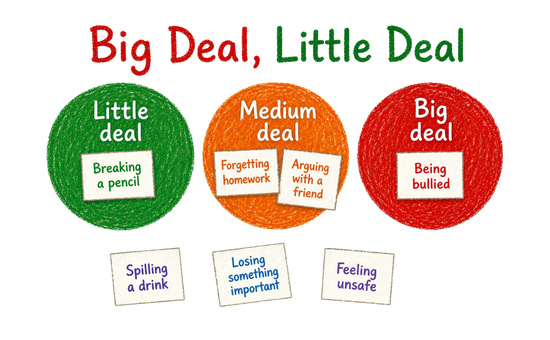
This image was generated using ChatGPT.
This activity isn’t about judging how your child should feel. Sometimes small deals can feel like big things, and that’s OK. You can use an emotional ladder picture to talk about how your child feels.
How to adapt this activity for children of different ages
Younger children (3-6 years)
- Use simple pictures instead of words.
- Keep problem examples short and concrete.
- Start with little deals (green) and big deals (red) and add in the medium deals (orange) when your child is ready to understand more than 2 problem sizes.
- Focus on what could help or who could help rather than expecting your child to solve problems on their own.
- Match the length of the activity to your child’s attention span and take breaks.
Primary school children (7-12 years)
- Separate the problem from the feelings to help your child identify what is happening as well as how they feel about it.
- Discuss problems that can’t be fixed.
- Help your child recognise when getting support or finding ways to cope can be better than trying to solve the problem.
Teenagers (13-18 years)
- Rate the problems on a scale from small to big (1-10). Teenagers might prefer this approach.
- Encourage your teen to identify what they can change, what they can influence, and what they might need to accept or seek support for.
This activity gives you the chance to learn about problems your child faces in their daily life, talk about how your child sees those problems, and understand what strategies your child has to deal with problems right now.
How to adapt this activity for children of diverse abilities
Communication difficulties
- Use simple language and encourage your child to show that they understand if verbal answers are difficult for them.
- Offer 2-3 options for your child to choose from. This can be easier for children who have difficulty expressing ideas.
- Use your child’s preferred communication mode. For example, pointing, role play, drawing or gestures.
Low vision
- Read examples aloud and describe any pictures, symbols or written information.
- Use accessible materials like large, clear print and position materials so your child can see them comfortably.
- Encourage your child to use verbal responses or props to identify problems.
Restricted mobility
- Position props or materials so your child can comfortably reach them.
- Let your child direct the activity. For instance, another person can move or sort problems according to your child’s instructions.
You can get more ideas for adapting this activity from our articles on play and autistic children and play and children with disability. You might also like to explore our other activity guides. They can all be adapted to suit children with diverse strengths and abilities.