
What are personal boundaries?
Personal boundaries are our own limits and rules for the ways we behave around people and the ways people behave around us.
Personal boundaries reflect what feels safe and reasonable.
Why is it important for kids to learn about boundaries?
When children learn about their own and other people’s personal boundaries, it helps them understand how to behave and what to expect in different social situations and relationships.
For example, a child might have personal boundaries for:
- touching other people
- being touched
- sharing things about themselves with others.
An understanding of personal boundaries also helps children recognise inappropriate, unsafe or unwanted behaviour. This means they’re more likely to say no to this behaviour or to ask for help if it happens.
What is a circle of friends?
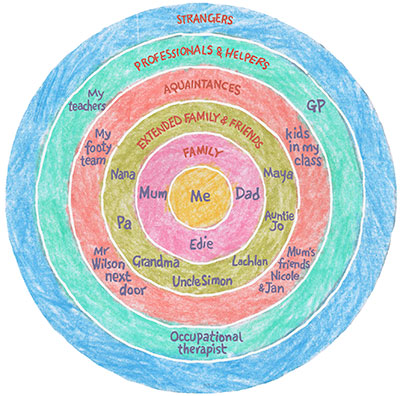
A circle of friends is a picture that shows different people in your child’s life.
Your child is in the middle, and people are in concentric circles around your child. The people your child feels closest to are in the first circle, and strangers are furthest away.
A circle of friends can help your child see the boundaries between themselves and other people.
Here’s an example of a circle of friends picture. Download and print this circle of friends example (PDF: 379kb).
What you need to make a circle of friends with your child
You and your child can make a circle of friends together.
You’ll need:
- a large piece of paper
- pencils or felt tip pens.
You might also need photos of your family and your child’s friends.
How to make a circle of friends with your child
- Start with a big piece of paper and ask your child to draw a picture of themselves in the middle. Or they could stick a photo of themselves there. Ask your child to draw a circle around themselves.
- Draw a larger circle around your child’s circle. In this circle, ask your child to add the people they feel closest to and safest with. Encourage your child to choose based on how people behave. For example ‘Who respects your rules and makes you feel safe?’ Your child could write their names, draw pictures of them or stick photos of them here.
- Draw a larger circle around the first 2 circles. In this circle, ask your child to add people who are close to them but not quite as close as those in the first circle. They could be extended family or your child’s best friends. Talk with your child about who they think should be included and why.
- Draw another circle around the other circles and add acquaintances. These are people your child knows but isn’t close to. They could be family friends or people in your child’s wider group of friends, in their class at school, or on their sports team. Talk with your child about who they think should be included and why.
- Draw another circle and add professionals and helpers. These are people whose jobs are to help your child. They might be teachers, doctors, counsellors or carers.
- In the outside circle add strangers. These are people your child doesn’t know – for example, the postie or people at the supermarket.
It’s OK if your child doesn’t want to include someone or feels differently about people from the way you expect. You might even discover that your child feels comfortable with a person or behaviour you think isn’t OK. This activity helps you understand and talk about your child’s feelings and guide your child towards safe choices.
How to use the circle of friends to help your child understand personal boundaries
What to talk about
This circle of friends activity can get you and your child talking about:
- who’s in their life – who they feel close to and safe and comfortable with
- how they can interact with people – what’s safe, comfortable and OK
- how people should talk, behave and touch them – what’s safe, comfortable and OK
- how they know when other people are behaving in ways that are not safe, comfortable or OK
- what to do when someone’s behaviour makes them feel uncomfortable or unsafe.
How to talk
You could ask questions like these:
- ‘How would you greet people in this circle?’
- ‘Which people would it be OK to kiss or hug?’
- ‘Who would you invite to your house for dinner?’
- ‘Would it be safe or appropriate to sit in this person’s lap?’
- ‘Which people do you feel comfortable hugging or holding hands with?’
- ‘Which people do you feel safe with collecting you from school?’
- ‘What do you think is safe behaviour?’
- ‘What happens in your body when something is not safe or OK?’
- ‘Who could you talk to if you’re worried about something?’
Key messages for your child
- ‘No-one has a right to touch you. This includes people in your inner circles.’
- ‘You can say no to physical contact, including from people in your inner circles.’
- ‘Safe people will never ask you to keep secrets.’
- ‘Safe people will never ask you to behave in ways that make you feel uncomfortable.’
- ‘Your body will tell you when something is unsafe or uncomfortable. For example, you might feel butterflies in your stomach, jelly legs or a racing heart.’
It’s also good to talk with your child about child sexual abuse. It’s never a child’s responsibility to protect themselves from abuse. But learning they can say no to unwanted touch or activity helps them stand up for themselves and set their own boundaries.
How to adapt this activity for children of different ages
Younger children
Your child might need help working out who to put into each circle. You could ask them to think about people they feel safe, happy, relaxed and comfortable spending time with.
You can give your child ideas, but it’s best to avoid suggesting specific people. This might make your child feel they have to put certain people in a circle, even if they don’t feel comfortable or safe with them.
Your child might also need help drawing the pictures and circles. Try to guide your child by holding their hand while drawing the circle, rather than just doing it for them.
Older children
Your child might want to do the activity more independently. Your child could add people to the circles, and then you could talk together about why they’ve chosen those people and which people are safe. Encourage your child to think about any people they’ve missed.
It might help to keep the circle of friends picture somewhere that’s easy to see and refer to, like on the fridge or bedroom wall.
How to adapt this activity for children with diverse abilities
For children with disability, it’s a good idea to think about all the people in your child’s circles, including carers or other support people.
Autism, cognitive disability, developmental delay and language disorder
You could use visuals like pictures and photos alongside clear, simple language when talking about the activity.
Your child might also need help to think about who should go into each circle. You could:
- say the name of a family member or support worker, and they could give a thumbs up or down
- show pictures of different people and professionals, and your child could point to who goes in which circle.
Physical disability
Your child might need help with drawing their circle. Or they could use digital tools or a device to draw it.
You can get more ideas for adapting this activity from our articles on play and autistic children and play and children with disability. You might also like to explore our other activity guides. They can all be adapted to suit children with diverse strengths and abilities.