
Signs that your autistic child is ready for toilet training
Autistic children generally show the same signs of readiness for toilet training as typically developing children. But these signs might appear when autistic children are older, and the process might take longer.
If your autistic child is ready for toilet training, they might be able to:
- tell you (or show you with a sign or gesture) that they’ve wet or soiled their nappy or clothes
- follow a simple instruction like ‘Sit on the toilet’
- pull their pants up and down
- do regular, formed bowel movements
- stay dry for at least 2 hours during the day.
Before you start toilet training, it’s a good idea to speak with your child’s paediatrician or GP. They can rule out any medical problems that might get in the way of toilet training and say whether your child is ready to start.
Strategies to help your autistic child with toilet training
The steps to toilet training are much the same for all children. But your autistic child might need extra strategies and support, including:
- encouragement and rewards
- social stories
- video modelling
- visual supports.
It’s a good idea to try a combination of these strategies to see what works best for your child.
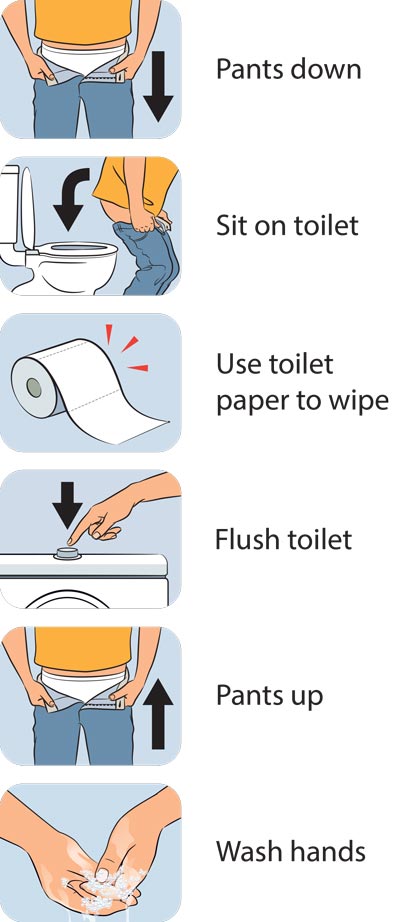
Regardless of which strategy or combination of strategies you use, it’s good to break the toileting process into steps. You can teach these steps to your child one at a time – for example, pull pants down, sit on the toilet, wipe bottom and so on.
Strategy 1: praise and encouragement
If you praise and reward your child during toilet training, it can encourage them to keep trying.
For example, you could praise or reward your child for things like:
- recognising they need to go the toilet
- sitting on the toilet
- washing their hands
- using a visual support to ask for help
- accepting help.
It’s important to praise and reward your child in ways that work for them. You could try:
- descriptive praise – for example, ‘Charlie, well done for sitting on the toilet’
- nonverbal praise, gestures (clapping) or signs (thumbs up)
- quiet or low-pressure acknowledgement – for example, ‘Sia, you washed your hands’
- a preferred activity – for example, playtime with trains
- visual charts, stickers or reward charts.
We used a reward system – Sesame Street stickers for wee and a lucky dip bag for poo. He caught on straight away for his bladder, but it took longer with his bowels. We just kept asking if he needed to poo and waved the lucky dip bag in front of him, making it very clear he would get something if he went. One day something just clicked for him and we haven’t had an accident since.
Strategy 2: social stories
Social stories can help your autistic child cope with challenging or confusing situations like toilet training.
Experienced speech pathologists, occupational therapists or school teachers will be able to help you create a social story for your child to use during toilet training.
If your child will be going to the toilet at a friend’s home or somewhere else other than home, practise a new story for this situation with your child ahead of time. When the event happens, the story can help your child know what to do.
When you’re writing a social story, use words and pictures that your child can understand. Suggest possible responses and behaviour, rather than making the story an exact ‘script’ to follow.
Strategy 3: video modelling
Video modelling can support your child’s learning. For example, you and your child could watch animations that show children doing each step of going to the toilet.
Strategy 4: visual supports
Visual cues and prompts can be a good option for autistic children:
- Use the Picture Exchange Communication System (PECS) or another visual aid to create a visual support that shows the steps in using the toilet.
- Stick the schedule on a wall close to the toilet or potty to remind your child of the steps.
- Go over the schedule with your child 2-3 times a day.
- Ask everyone who does toileting with your child to follow the schedule. This way, your child’s toilet training will be consistent.
Download and print an A4 version of this visual aid for toileting (PDF: 111kb).
How to adapt toilet training strategies to your autistic child’s needs
- Skip the ‘potty’ stage if your child has difficulty with change. If you start with a toileting-specific seat on the toilet, this limits the number of changes for your child.
- Make going to the toilet part of your everyday routine. For example, ask your child to sit on the toilet at the same times each day.
- Start with sitting on the toilet for a short time and build up to a maximum of 5 minutes. Sitting on the toilet for too long can make your child feel that they’re being punished.
- Choose and use only one word for the toilet. Get everyone in the family to use it. For example, always say ‘toilet’ or ‘loo’. If you use various words, it can be confusing for your child.
- Use specific language when talking about going to the toilet. For example, say, ‘Eddie, sit on the toilet and do a wee’. This helps your child understand what to do.
- Teach your child how to let you know they need to go to the toilet. This could include nonverbal signing or using the Picture Exchange Communication System (PECS).
For our son, it all revolved around change. We started by teaching him to wee in the garden, then into a bucket in the garden, then into a bucket inside, then into a bucket next to the toilet, then finally into the toilet. This took nearly a year! I tried to make the toilet a happy place for him to visit by putting Bob the Builder stickers all over the door and letting him have little matchbox cars.
How to handle toilet training challenges and setbacks in autistic children
Challenges and setbacks are part of toilet training for all children.
For autistic children, these challenges can include:
- challenging behaviour
- sensory sensitivities
- constipation
- lack of progress.
Challenging behaviour
Sometimes autistic children might:
- be afraid of the toilet
- go in places other than the toilet
- fill the toilet with paper and other materials
- continually flush the toilet
- smear poo on the wall and other places
- refuse to poo.
This behaviour can be a sign of distress, discomfort, pain, fear, sensory overload, confusion or communication difficulties.
A GP, paediatrician, occupational therapist, psychologist, speech pathologist or continence nurse can help you understand why your child is behaving this way and how to support your child.
Sensory sensitivities
If your autistic child is sensitive to the sensory aspects of going to the toilet, try to make the environment and experience more comfortable. For example:
- Try washable training underpants. These help your child become aware of feeling wet. When the pants get wet, you can point this out in a positive way. For example, ‘Your pants are wet. That means you did a wee. Next time you could use the toilet’.
- Control the environment. For example, if the floor is cold, put socks on your child’s feet. Make the temperature in the toilet similar to the rest of the house. Check that the light isn’t too bright.
- Put a stool in front of the toilet for your child’s feet. This can help your child to sit comfortably and feel more stable.
- Use a training seat if your child is frightened of the big hole over the water. Encourage your child to sit on the seat for a few minutes every day.
- Tell your child there will be a noisy, flushing sound, and explain why. Let your child practise flushing or wear headphones if they find the noise distressing.
- Let your child hold a favourite object while they sit on the toilet.
Constipation
If your autistic child avoids doing poos, it might be constipation.
Some autistic children are selective eaters, which can cause them to become constipated more easily than other children.
If you think your child is constipated, see your paediatrician or GP.
Lack of progress
Sometimes toileting progress stops, slows down or seems to go backwards. This can happen for many reasons, including stress, illness, changes in routine or environment, sensory overload, constipation or diarrhoea.
If this happens, you could keep a record of when your child wees or poos in their pants. If a pattern develops over a week or so, target these times by taking your child to the toilet just before your child would normally wee or poo in their pants.
Or you might notice that your child wees in their pants when they’re away from home. This might be because your child doesn’t like the sensory environment of unfamiliar toilets. There are tips for managing toileting sensitivities above.
If toilet training starts to feel pressured or distressing, take a break for now. Consider starting the training again in about 3 months. It might just be that your child isn’t ready right now or needs more time.
Video: Toilet training for autistic children
This episode of Late Night Notes covers how to tailor toilet training for your child’s needs, practical strategies to help autistic children with toilet training and how to make sure you’ve got the support you need.