
About impetigo or school sores
Impetigo or school sores is a skin infection caused by bacteria.
Bacteria can get into the skin through a cut, scratch or sore. Because the skin is broken, it can’t act as a barrier against the bacteria. The bacteria grow in the sore and stop it from healing normally.
If a child touches the sore and then touches somewhere else on their body, the bacteria can spread. This can cause more impetigo sores to develop on the body.
Impetigo is highly contagious. It can spread to other people through physical contact. Objects like towels, sheets and toys can also spread the sores to other people. It’s quite common for there to be outbreaks of impetigo in schools and child care centres.
Impetigo often occurs on top of other skin conditions like eczema, scabies, head lice, insect bites or chickenpox.
Impetigo is more common in the warmer months.
You can have impetigo at any age, but it’s most common in children under 10 years of age.
Symptoms of impetigo or school sores
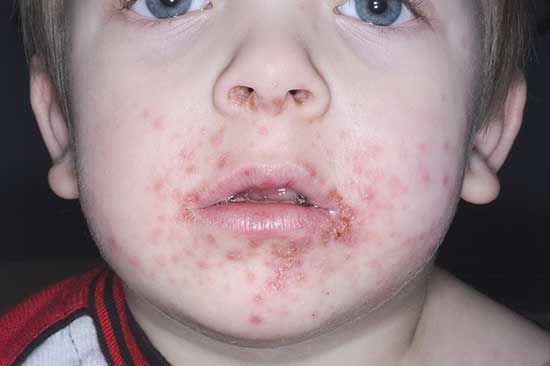
In the early stages of impetigo, you might notice flat spots or small blisters on any part of your child’s body. These spots are especially common around the mouth, nose, hands and legs. On children with light skin, the spots might look red. On children with dark skin, the spots might look brown, purple or grey.
The spots might fill up with yellow or green pus, burst or crust over. The bacteria are in the liquid and crusts of the sores. If you don’t treat the sores, they might get bigger and more of them might grow. They can be itchy and tender.
In severe cases, the skin surrounding the blisters might change colour and feel warm. Your child might also have fever, tiredness or a loss of appetite.
Complications from impetigo or school sores
In rare cases, impetigo can cause complications.
Children with impetigo, particularly those under 6 years of age, are at risk of a complication called staphylococcal scalded skin syndrome. This is a serious skin infection, and its symptoms include:
- severe blisters on the face, underarms, groin and body
- significant pain
- fever.
Other complications from impetigo include kidney disease and other skin infections like cellulitis and scarlet fever.
Medical help: when to get it for children and teenagers with impetigo or school sores
You should see your GP if your child:
- has impetigo symptoms
- has a sore and the skin around it has changed colour or feels warm and tender
- has a crusted or weeping sore, especially if the sore is getting larger or spreading
- is also generally unwell or has a fever.
Tests for impetigo or school sores
Your GP will take a swab of the infected sores and send it for testing. This can identify the bacteria that’s causing the impetigo infection, and it helps your GP know which antibiotic will work best against it.
Treatment for impetigo or school sores
If the impetigo sores are small and aren’t blistering, you can apply an over-the-counter antiseptic cream from your pharmacy 2-3 times a day.
But most cases of impetigo need a prescribed medication like an antibiotic ointment, tablet or liquid. Your child must take the full course of antibiotics, or the infection might come back.
In between putting the ointment on the infected spots, gently wash your child’s skin with soap or an antibacterial solution, and then pat dry.
You can remove the crusts from your child’s skin by getting your child to soak in the bath for 20-30 minutes to soften the scabs. You can then gently wipe away the crust with a towel. Removing the crusts can help prevent the sores from spreading and allow them to heal.
Cover sores with a watertight dressing.
The sores usually heal without scarring.
Treating impetigo early and effectively can help to stop it from spreading. It can also reduce the chance of complications.
Prevention of impetigo or school sores
If your child has impetigo, there are several things you can do to prevent the sores from spreading to other parts of your child’s body and to other people:
- Remove crusts by following the instructions above.
- Use separate towels for different areas of impetigo. Don’t use these towels to dry areas without impetigo.
- Keep your child’s fingernails short.
- Encourage your child not to pick at or scratch sores. Cover the sores with a watertight dressing to help with this.
- Be extra careful with hand-washing. It’s very important to wash your hands after touching any sores.
- Give your child a diluted bleach bath. Check with your GP about how many bleach baths are recommended.
- Use hot water to wash towels, sheets, soft toys and anything else that has come into contact with blood, pus or sores. Dry in hot sun or in a hot clothes dryer.
To reduce your child’s chances of getting impetigo, wash any bites, cuts, grazes or areas of eczema carefully and keep them clean. These can be points of entry for the bacteria that cause impetigo. It’s also important to treat any other skin conditions your child has.
If your child has impetigo, you should keep them home from child care, preschool or school for at least 24 hours after starting treatment.